
Craftsmanship behind every key
At Piano’s Maene, every pre-owned upright and grand piano is carefully prepared by our internally trained piano technicians. They repair and regulate each instrument wherever necessary, restoring the ideal balance between touch, action and tone. Discover below how we prepare every instrument down to the finest technical detail.
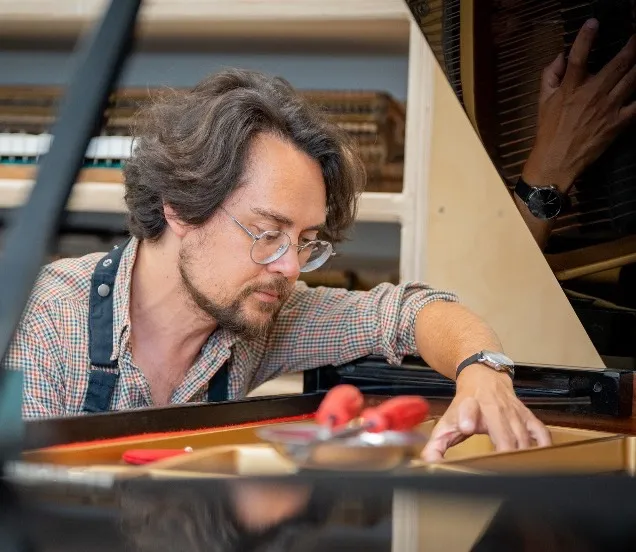
Thorough technical inspection
The preparation process begins with a complete inspection. Every key is played, while the keyboard, action, hammers, strings, tuning pins, dampers and pedals are carefully checked. The soundboard, bridges and overall stability of the instrument are also inspected.
Our piano technicians look beyond visible signs of wear, also assessing the playability, the responsiveness of the action and any unwanted noises. This provides a complete picture of the instrument’s technical condition.
No two pre-owned pianos are identical. Our technicians therefore determine individually which work is required for each instrument.
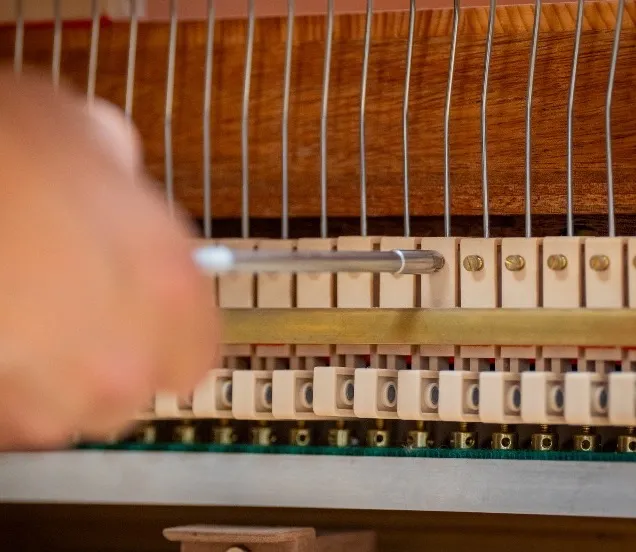
Repair and reconditioning where necessary
Before a piano can be regulated correctly, every component must move smoothly and precisely, without any unwanted play. Loose parts are secured, while worn or damaged components are repaired or replaced where necessary.
The keys and their guides are inspected, together with the many pivot points and connections within the action. The hammers are also checked for wear, shape and alignment. Whenever possible, they are carefully reshaped. Components that are excessively worn are replaced.
We always seek the right balance between preserving original components and ensuring a technically reliable repair. This reconditioning process provides a solid foundation for the further regulation of the instrument.
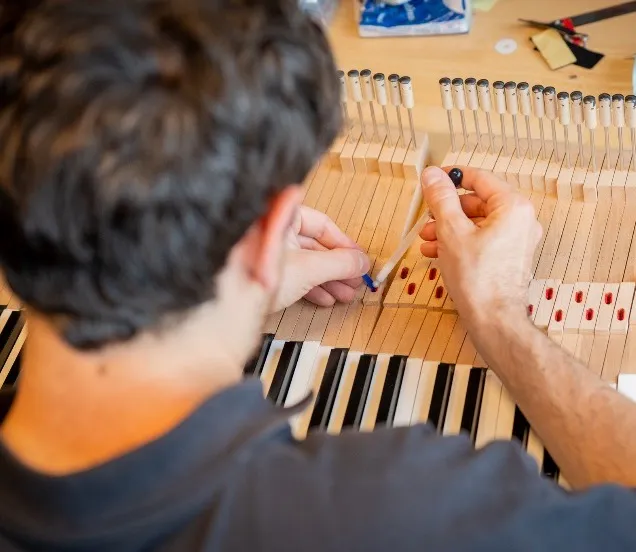
Precise regulation
The keyboard and action are then fully regulated. The keys are levelled to the same height and the key depth is adjusted with precision. This ensures an even and predictable touch across the entire keyboard.
The action is also regulated with great care. The distance between the hammers and strings, the moment at which the hammer is released and the way it is caught after striking are all precisely adjusted. This ensures a reliable response, allowing the pianist to play both softly and with control, as well as with power.
On a grand piano, the repetition mechanism is also precisely regulated, allowing rapid note repetitions to be played smoothly and with complete control.
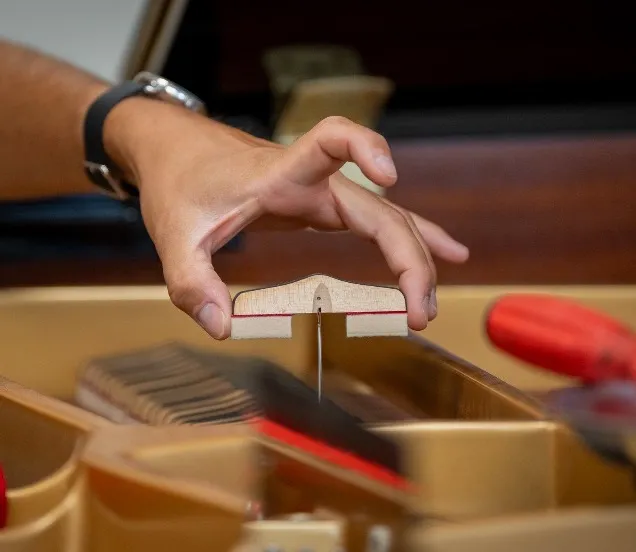
Hammers, dampers and pedals
Each hammer is correctly aligned so that it strikes the appropriate string or group of strings straight and evenly. This is important for both the tone and the even wear of the instrument. The relative position of the hammers is also carefully checked, allowing every note to sound clear, full and balanced.
The dampers are precisely regulated so that they release the strings completely at the correct moment and damp them quickly and evenly when a key is released. This allows notes to stop sounding clearly and in a controlled manner, without unwanted resonance or distracting noises.
The pedals are also inspected and adjusted to ensure that they operate smoothly, quietly and at precisely the right moment. This allows the dampers and pedals to respond accurately to the pianist’s playing, maintaining optimal control over the sound.
Tuning and voicing
After the technical repairs and regulation, the piano is carefully tuned. All strings are brought to the correct tension and accurately tuned in relation to one another. When the instrument deviates significantly from the correct pitch, a pitch correction may first be required.
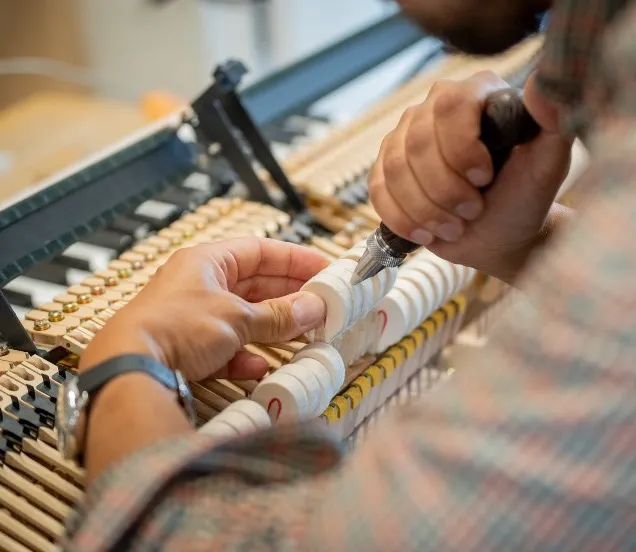
This is followed by voicing, during which the tone colour is balanced across the entire keyboard. Our piano technicians listen to every note at both soft and powerful dynamics and carefully treat the hammer felt where necessary, for example using fine voicing needles. If required, the hammers are also reshaped so that they strike the strings evenly.
The aim is to achieve a homogeneous and expressive tone, offering warmth and control during soft playing, together with sufficient clarity, projection and power at stronger dynamics.
Comprehensive final inspection
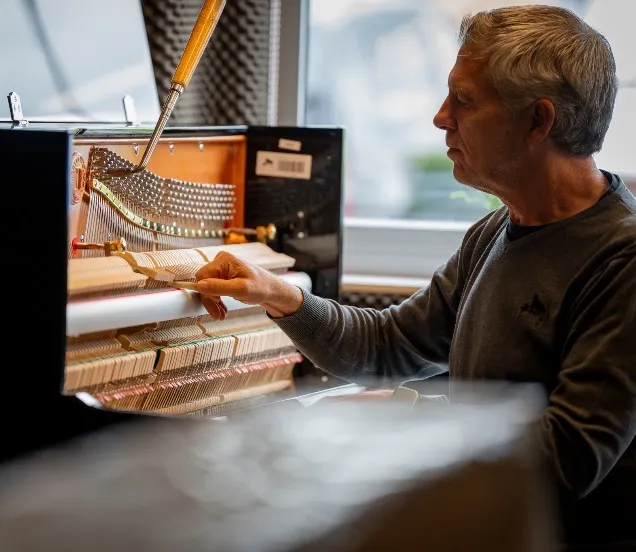
Finally, the instrument is played throughout and extensively tested. Every key, damper and pedal is checked at soft, normal and powerful dynamics. Rapid repetitions, tuning, tonal balance and any unwanted noises are also carefully assessed.
Following this final technical inspection, the instrument is also evaluated by an experienced and trained pianist. The piano is tested from a musical perspective, with particular attention paid to the touch, dynamics, control and tonal development. Only when both the piano technician and the pianist are fully satisfied is the instrument approved for sale in our stores.
This allows us to guarantee that every pre-owned upright and grand piano offered by Piano’s Maene is technically reliable, enjoyable to play and possesses a beautiful, well-balanced tone.
